Britain's certified plug-in solar kits. No scaffolding, no installer.
A panel on a frame, a cable and a three pin plug. It goes in the garden, on a balcony or on a flat roof, and feeds the house while the fridge, the kettle and the router pull it back out, so you buy less from the grid. Unplug it and take it with you if you move.
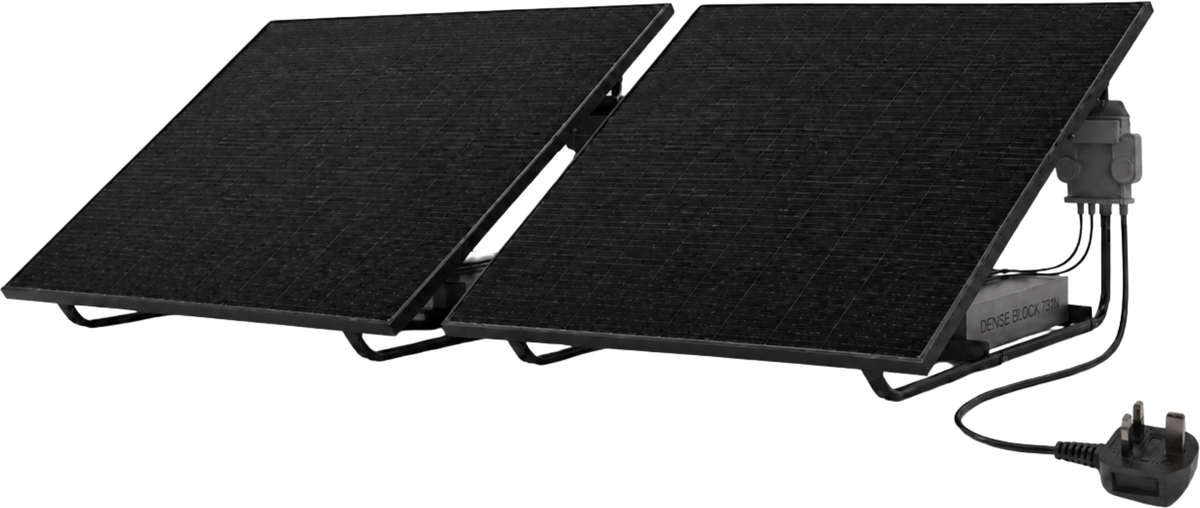
Two kits.
Every kit ships complete: panels, micro-inverter, mounting hardware and cabling. Nothing else to buy.
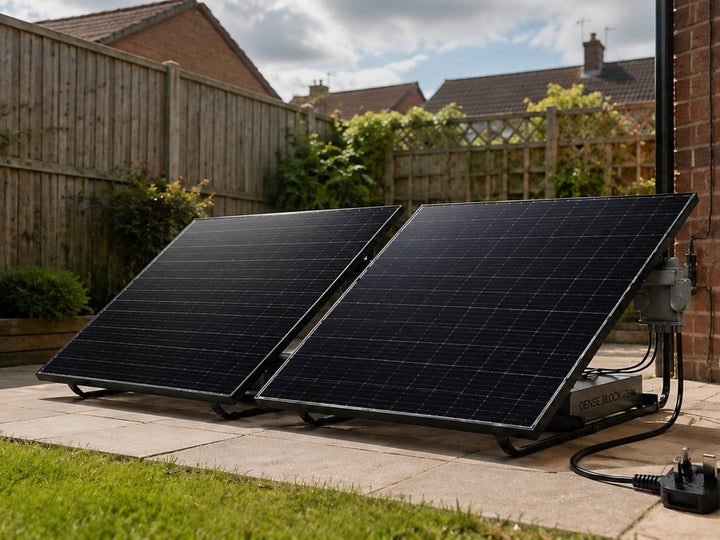
Duo 890W Plug-in Solar Kit - British Assembled
Two panels on a British made ground frame. For gardens and patios, not balconies.
Click for more information
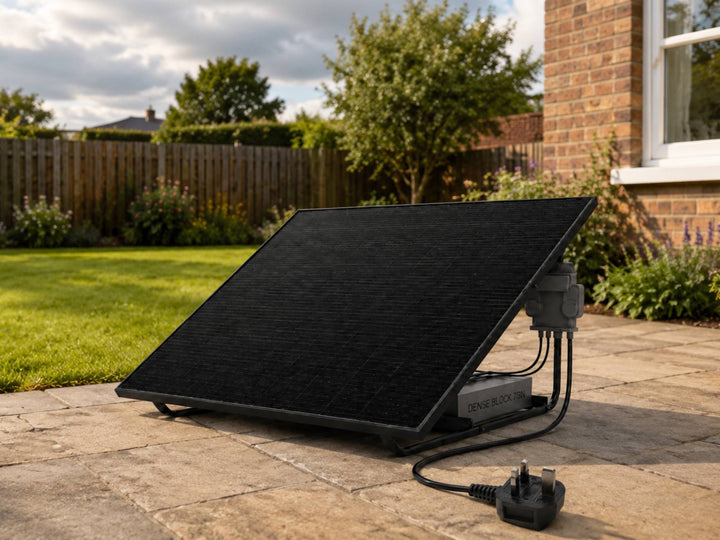
460W Plug-in Solar Kit - British Assembled
Single panel on a ground frame. For gardens and patios, not balconies.
Click for more information
Every kit is certified as a complete product to the UK specification.
It really is this boring to set up
No electrician, no roof access, no hole drilled in anything. If you can hang a bike on a wall you can do this.
Mount the panel
A British made ground frame for gardens and patios. It arrives flat, goes together with the bolts in the box, and needs no fixing to the house.
Clip in the inverter
The micro-inverter turns the panel's DC into normal 230V AC. It clips to the back of the frame and connects with one push-fit lead.
Plug it in
Straight into an ordinary three-pin socket, using the fused plug that comes fitted. Notify your network operator with the QR code on the kit and you're done.
What is actually happening
The panel makes DC. The micro-inverter turns it into ordinary 230V AC and caps the output at 800VA, which is the legal limit. From there it is a normal cable and a normal fused plug into a normal socket.
Whatever your home is using at that moment gets taken from the panel first. Anything left over goes to the grid.
Illustrative figures, not a live system. Real output depends on siting, shading and weather.
Where UK law sits on this
Legal to plug in and self-install from 27 August 2026, for certified kits only
SI 2026/848 comes into force on 27 August 2026. It creates a legal category called a plug-in microgenerator and allows it to connect through an ordinary three-pin socket without an electrician.
Only complete kits certified to the government's interim product specification qualify. A UKCA mark on the inverter alone is not enough, and neither is a European kit with a UK plug fitted to it.
The limits: 800VA of inverter output and 3.5A maximum, one device per household, solar only with no battery in the kit, and a factory-fitted fused plug with no extension leads. You must still notify your network operator under G98 before you connect.
Straight answers
Which way should the panel face?
South is best. North loses roughly 60 to 70 percent against south, so it is not worth it. East or west is fine and gives you a longer, flatter generation curve, which often suits a household better than a sharp midday peak.
I've seen the same panels cheaper on a marketplace. What's the difference?
Almost certainly certification. Only kits certified as a complete product to the UK specification can legally be plugged into a socket. Plenty of listings are European kits with a UK plug on the end, which does not qualify however good the hardware is.
Ask any seller to confirm the kit is certified as a complete product to the UK specification, not just that the inverter carries a mark. If they cannot, you are buying something you will have to pay an electrician to hardwire.
Can I buy two and double it?
No. The rules allow one plug-in device per household. More generation than 800VA means a conventional installation with an electrician and a full application to your network operator.
Does it come with a battery?
No, and it can't. Battery systems are specifically excluded from the plug-in category in law, so anything sold as a plug-in kit with storage built in doesn't qualify to be plugged into a socket.
Do I need to tell anyone?
Under G98 rules, notification is mandatory—even though an electrician is no longer required. Be sure to submit this before you connect, not after. Additionally, if you don't own your building outright, you must inform your landlord or freeholder. Enter your postcode here to find your local DNO.
What happens in a power cut?
It shuts down. Grid-tied micro-inverters must disconnect when they lose the mains, so it won't keep your lights on. If you want backup power you want a battery system, which is a different product and a much bigger bill.